
Many discussions surrounding Battery Energy Storage System (BESS) safety focus on thermal runaway and fire. However, a significant risk can develop before visible flames are present: the accumulation of flammable gases within an enclosure that can lead to a deflagration or explosion.
The explosion at the Arizona Public Service (APS) McMicken BESS facility in Arizona on 19 April 2019 highlighted how internal cell failure and thermal runaway can create hazards beyond fire alone. The incident prompted continued development of industry guidance, hazard mitigation analysis requirements, enclosure design standards and off-gas detection strategies.
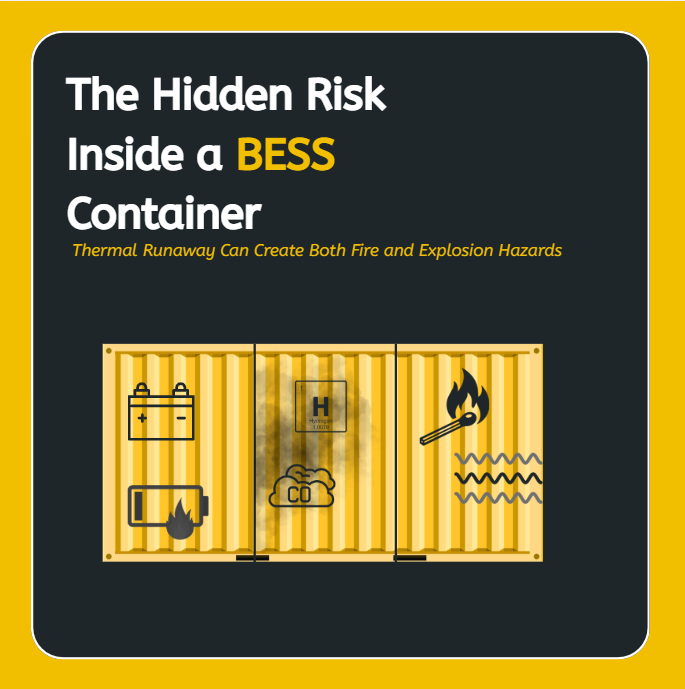
What Gets Vented in BESS and Why It Matters
Cell failure is a common trigger for thermal runaway, causing electrolyte components to decompose into high-pressure, toxic gases. Understanding which gases are released and how they behave is critical for system designers, operators and emergency responders.
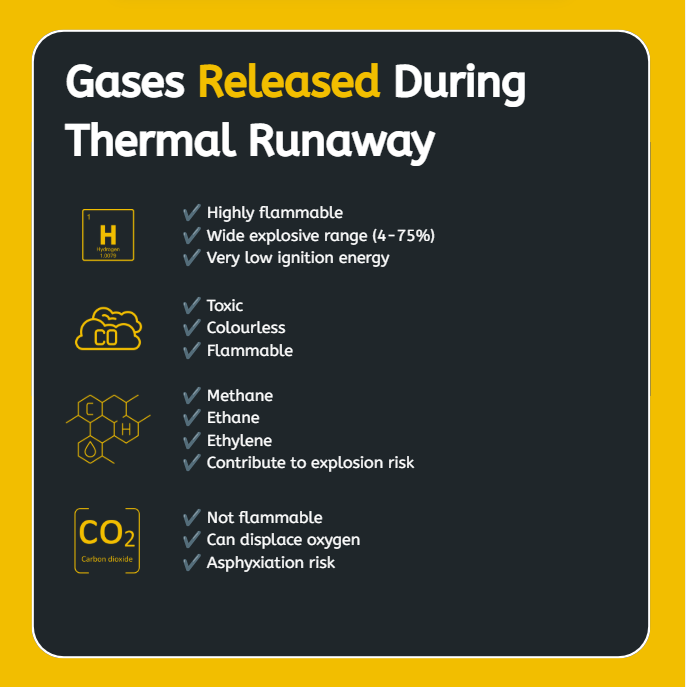
The main gases vented during thermal runaway can include:
Hydrogen (H₂)
Hydrogen is the lightest element and disperses rapidly when released. However, it also has a wide flammable range of approximately 4-75% in air and requires very little ignition energy. Static electricity can be sufficient to ignite a flammable hydrogen-air mixture, making it a significant explosion hazard.
Carbon Monoxide (CO)
Carbon monoxide is a colourless, odourless and highly toxic gas. In addition to its health risks, it is also flammable and can contribute to the overall fuel load within an enclosure.
Hydrocarbons
Hydrocarbon gases such as methane, ethane and ethylene may be generated as electrolyte materials break down under elevated temperatures. These gases can contribute to a potentially explosive atmosphere if allowed to accumulate.
Carbon Dioxide (CO₂)
Although non-flammable, carbon dioxide can displace oxygen within an enclosure and create an asphyxiation hazard for personnel entering affected areas.
The composition, volume and temperature of vented gases vary significantly depending on battery chemistry. In general, lithium-ion systems are commonly grouped into two broad categories:
Nickel Manganese Cobalt (NMC)
- Thermal runaway temperatures can exceed 600-700°C.
- Oxygen can be released as cathode materials decompose, helping sustain combustion.
- Gas venting can occur rapidly and may contain high concentrations of toxic compounds, including hydrogen fluoride (HF).
Lithium Iron Phosphate (LFP)
- Typically produces lower peak temperatures than NMC chemistries.
- Does not release oxygen in the same way as NMC cells, making self-sustaining combustion less likely.
- Despite this, LFP batteries can still generate significant quantities of combustible and toxic gases, including hydrogen and carbon monoxide.
Efforts to understand and mitigate these hazards are supported through testing methodologies such as UL 9540A, which helps determine gas generation rates, thermal behaviour and safe separation distances.
How Gas Accumulates Inside Enclosures
BESS containers are intentionally designed to be weatherproof and tightly sealed to protect sensitive equipment from environmental conditions. However, this same design can create challenges during a battery failure event.
During thermal runaway, cell temperatures can exceed several hundred degrees Celsius depending on battery chemistry and failure mode. Rapid decomposition of internal materials generates large volumes of gas, which are vented through pressure relief mechanisms designed to prevent individual cells from rupturing catastrophically.
A single battery module can release hundreds of litres of gas during thermal runaway. As gas accumulates, oxygen concentrations may decrease while flammable gas concentrations increase.
Depending on enclosure conditions, vented gases may accumulate and create an atmosphere that is either too fuel-rich or within the flammable range. Changes in ventilation, enclosure integrity or oxygen availability can shift conditions rapidly, increasing the risk of ignition.
This is why explosion risk assessment is just as important as fire detection when designing BESS protection strategies.
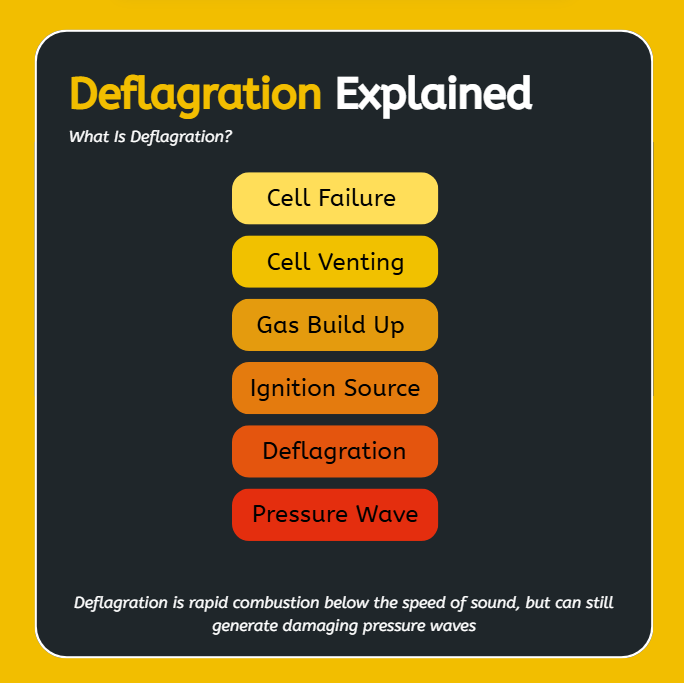
What Is Deflagration in Thermal Runaway?
Deflagration is a rapid, subsonic combustion process that propagates through a flammable gas mixture by heat transfer.
Although often described as an explosion, deflagration differs from detonation because the flame front travels below the speed of sound. However, the resulting pressure wave can still be severe enough to damage structures, equipment and enclosure doors, posing significant risks to personnel and emergency responders.
Within a confined BESS enclosure, accumulated flammable gases can create the conditions necessary for deflagration if an ignition source is introduced.
Why Detection Alone Isn’t Enough
Gas detection provides a critical early warning of developing thermal runaway conditions, but detection alone does not stop the event from escalating.
Instead, gas detectors provide valuable information that enables mitigation systems to act before dangerous concentrations are reached.
For example, hydrogen or electrolyte gas sensors may provide early indication that cell venting has begun. However, without additional intervention, heat can continue to spread through adjacent cells and battery racks, potentially creating a domino effect.
If the detection system is not integrated with mitigation measures such as emergency extraction, isolation or suppression systems, gas concentrations may continue increasing until a flammable atmosphere develops.
Under DSEAR principles, detection should form part of an integrated risk reduction strategy. Alarm systems become significantly more effective when linked directly to engineered mitigation measures such as ventilation, isolation and suppression systems.
Explosion Prevention & Protection: What the Standards Include
NFPA 855
NFPA 855 provides requirements for the installation of energy storage systems, including considerations for spacing, fire protection, emergency planning, hazard mitigation analysis and risk management.
UL 9540A
UL 9540A is a test methodology used to evaluate thermal runaway behaviour, fire propagation and gas generation characteristics of battery systems under failure conditions. The results help inform hazard mitigation strategies and support compliance with relevant safety standards.
NFPA 69
NFPA 69 focuses on explosion prevention systems. In BESS applications, one of its key principles is maintaining gas concentrations below hazardous levels to prevent ignition and explosion risks from developing.
NFPA 68
NFPA 68 provides guidance on explosion venting and helps engineers calculate the vent area required to safely relieve pressure during a deflagration event.
Alarm Thresholds & Staged Responses
Effective monitoring operates across multiple alarm levels, allowing operators to respond appropriately as conditions develop.
Parts Per Million (ppm) – Early Warning
This measures trace gas concentrations at very low levels.
Benefits include:
- Detection of early cell venting events before full thermal runaway develops.
- Increased response time for operators and automated safety systems.
- Improved situational awareness for maintenance teams.
Percentage of the Lower Explosive Limit (%LEL)
This measures how close a gas mixture is to becoming flammable.
Benefits include:
- Monitoring escalation towards explosive conditions.
- Initiating automatic ventilation systems.
- Supporting explosion prevention strategies by maintaining safe concentrations.
Linking Detection to Ventilation, BMS & Suppression
Detection only reduces risk when it is connected to systems capable of acting on the information provided.
In a BESS container, gas detection should integrate with:
- Battery Management Systems (BMS)
- Ventilation and extraction systems
- Fire suppression systems
- Emergency shutdown systems
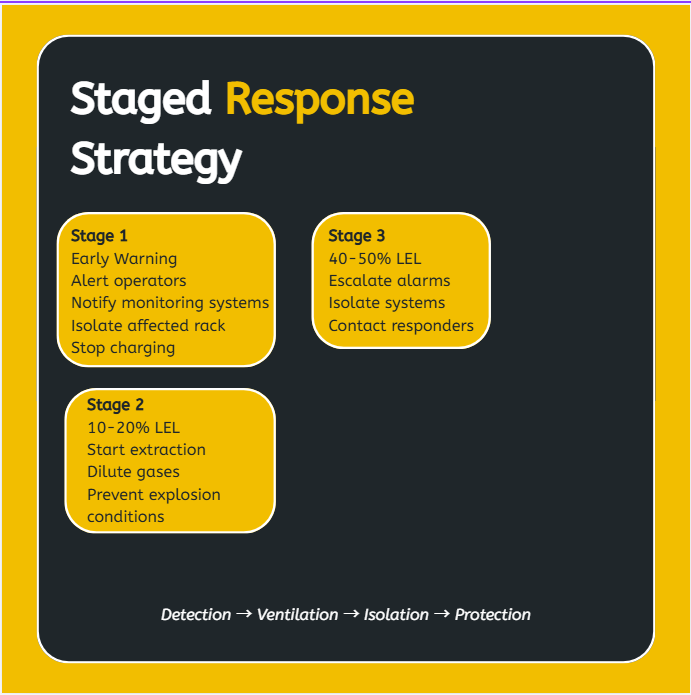
An example staged response strategy might include:
Stage 1: ppm-Level Alarm
- Alert operators.
- Notify remote monitoring systems.
- Have the BMS isolate the affected rack or string.
- Stop charging and discharging activity.
Stage 2: Low %LEL Alarm (10-20%)
- Automatically start extraction systems.
- Dilute gas concentrations.
- Maintain conditions below hazardous levels.
This aligns with the NFPA 69 principle of preventing explosive atmospheres from developing.
Stage 3: Higher %LEL Alarm (40-50%)
- Isolate electrical systems.
- Escalate alarms.
- Notify emergency responders.
- Ensure operating equipment is suitable for potentially hazardous atmospheres.
Timing is just as important as alarm thresholds. If extraction begins only after large volumes of gas have accumulated, introducing fresh air can unintentionally move the atmosphere into a flammable range. Ventilation strategies therefore need to be carefully engineered and tested.
Suppression systems can also create design challenges. Some technologies rely on maintaining enclosure integrity, which may conflict with extraction strategies. For this reason, ventilation and suppression systems should be designed, documented and tested as an integrated package.
The UK Picture: Planning, Insurers & Guidance
No dedicated UK legislation exists specifically for BESS fire and explosion safety. Instead, operators typically work within:
- General health and safety legislation
- DSEAR requirements where explosive atmospheres may occur
- Planning requirements
- Industry guidance
- Fire authority recommendations
In practice, fire and rescue services are increasingly consulted during planning applications and frequently request evidence relating to:
- Gas detection strategies
- Explosion control measures
- Emergency response planning
- Access arrangements
- Water supplies
- Separation distances
Insurers are also increasingly seeking evidence of UL 9540A testing, hazard mitigation analysis and documented safety strategies before providing cover.
A well-documented design based on recognised industry standards is generally far easier to justify to planners, insurers and emergency responders than implementing upgrades after an incident.
Practical Steps for BESS Operators
- Know your battery chemistry. NMC and LFP systems produce different gas profiles and hazards.
- Assess explosive atmosphere risks using enclosure volume, ventilation rates and gas generation data.
- Verify detector placement, considering gas behaviour, airflow patterns and extraction systems.
- Define alarm stages and associated actions before commissioning.
- Connect detection systems to mitigation measures such as BMS, extraction and suppression systems.
- Regularly calibrate and function-test detection systems.
- Review protection strategies whenever layouts, battery technologies or ventilation arrangements change.
Overall
Detecting off-gas is an essential first step, but it is only half the job.
A sealed BESS container can accumulate flammable gases long before visible fire develops. Detection systems provide critical early warning, but an alarm alone does not remove the hazard. Effective BESS protection requires a combination of early detection, staged alarm management, explosion prevention measures and automatic mitigation systems that act before conditions become critical.
At Protex Systems, we design, map and maintain fire and gas detection systems for high-hazard environments. From Fire & Gas Mapping and consultancy services through to detection system design, we help operators develop integrated protection strategies that address both fire and explosion risks within modern BESS installations.

