
The biomethane industry is growing quickly within the wider biogas sector. The National Energy System Operator (NESO) has projected that UK biomethane production could scale up roughly tenfold by 2050 as part of its Future Energy Scenarios, positioning it as a critical low-carbon fuel for the UK’s energy transition.
The UK currently has around 750 anaerobic digestion (AD) sites, producing an estimated 21 TWh of raw biogas each year, with a growing share of that upgraded and injected into the gas grid as biomethane.
Cadent, the UK’s largest gas distribution network, confirmed in 2026 that it has injected over 1.5 billion cubic metres of biomethane into its pipelines since 2013 — enough, in energy terms, to heat around 1.5 million homes for a year (source).
Why Is Biogas Upgrading Growing So Fast?
This growth is driven largely by decarbonisation and net zero commitments from government and industry. Regulations around low-carbon emissions and organic waste management have also pushed the shift from raw biogas to biomethane, since biomethane is a purified gas that closely matches the properties of natural fossil fuel gas.
The rollout of mandatory separate food waste collections across the UK has created a surge in raw feedstock, giving the AD industry more material to convert into low-carbon gas.
What Is Biogas Upgrading, and Why Does It Matter?
Biogas upgrading is the process of turning raw biogas — a localised, relatively impure fuel — into a high-purity, grid-ready resource that can replace fossil natural gas without disrupting the wider carbon balance.
Raw biogas produced by breaking down organic waste is typically only 50–70% methane, alongside other trace gases. This isn’t pure enough for grid injection, which generally requires methane purity in the mid-to-high 90s. Upgrading processes can raise that purity to around 99%, enabling grid injection.
High-purity methane also works efficiently as a low-carbon vehicle fuel, whereas raw, impure biogas is generally unsuitable for this. Raw biogas is typically limited to local, on-site power generation, while biomethane unlocks regional and national energy markets — and with them, longer-term revenue for producers.
Current Biogas Upgrading Technologies
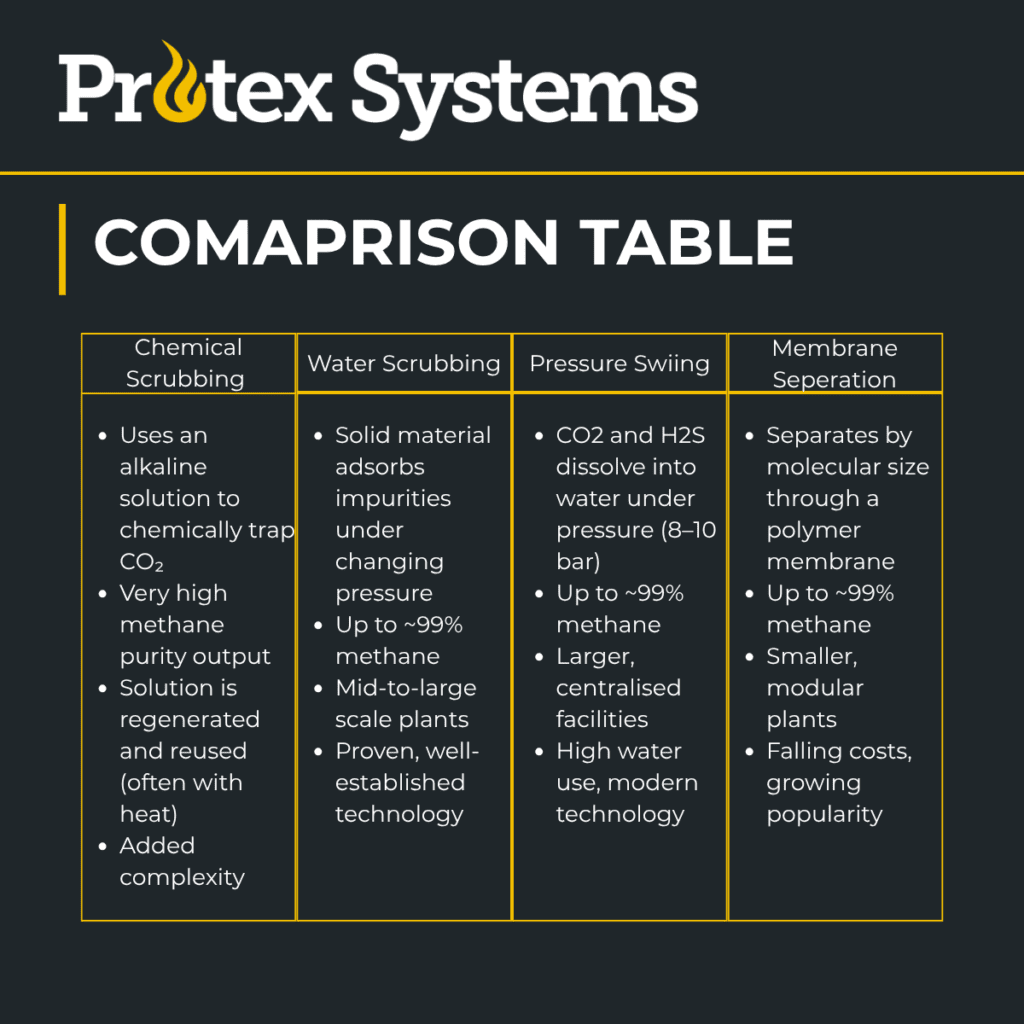
The main technologies used to convert raw biogas into pure biomethane are membrane separation, pressure swing adsorption, water scrubbing, and chemical scrubbing.
Membrane Separation
Compressed raw biogas flows across a specialised polymer membrane made up of hollow, microscopic fibres. Carbon dioxide, water vapour, and other trace gases have a smaller molecular size than methane, allowing them to pass through the membrane’s pores — a process known as permeation, producing what’s called the permeate stream. Methane molecules are larger and are largely retained on the other side, producing the retentate stream. This process is repeated several times until the methane concentration is almost pure.
Pressure Swing Adsorption (PSA)
This process uses a repeated cycle of changing pressure inside vessels filled with a solid adsorbent material to isolate pure methane.
High pressure: raw biogas is pushed into a high-pressure vessel containing the adsorbent. Waste gases are trapped on the solid material, while methane passes through.
Low pressure: once the vessel is saturated with waste gases, flow switches to a second, parallel vessel where pressure is dropped, releasing the trapped gases and regenerating the material for the next cycle.
Water Scrubbing
Biogas is compressed to around 8–10 bar and enters the bottom of a column, where water is sprayed downward through the rising gas. Carbon dioxide and hydrogen sulphide dissolve into the water, while methane does not, leaving a purified biomethane stream.
Chemical Scrubbing
This process also passes gas through a column, this time containing an alkaline chemical solution. The solution reacts with carbon dioxide and other impurities, trapping them, while methane passes through largely untouched — resulting in high-purity biomethane.
The Safety and Monitoring Challenges of Upgrading Facilities
High-pressure operations, where gases are compressed as part of the upgrading process, carry an increased risk if a valve or seal fails. A leak at these pressures can release a significant volume of flammable methane very quickly, and as it mixes with air, it can move into its explosive range.
Hydrogen sulphide presents its own hazard: at lower concentrations, its characteristic “rotten egg” smell becomes undetectable to the human nose, even though the gas is still dangerous. This means employees may not realise the gas is present or leaking — making an effective, continuously monitoring gas detection system essential rather than optional.
Upgraded systems also produce waste streams — such as separated carbon dioxide — that need to be safely vented or disposed of elsewhere on site. Controlling and detecting these gases is just as much a part of safe operation as managing the methane itself. https://protex.rawtechnologies.co.uk/fire-and-gas-mapping/
Regulatory and Market Drivers
The Green Gas Support Scheme (GGSS) provides a tariff payment for biomethane injected into the grid, supporting continued investment in new plants. In December 2025, the government confirmed plans to extend the GGSS commissioning deadline from 31 March 2028 to 31 March 2030, giving developers more time to commission plants and begin injecting gas.
Separately, biomethane used as a vehicle fuel rather than injected into the grid falls under the Renewable Transport Fuel Obligation (RTFO) and must be certified under that scheme before use.
The Future of Biogas Upgrading: Industry Outlook
A few trends stand out looking ahead:
Membrane separation is gaining ground. As manufacturing has scaled, the cost of membrane modules has dropped significantly, making membrane systems increasingly competitive against established technologies like water scrubbing and PSA — particularly for smaller and mid-sized plants that need something modular and straightforward to operate.
Smaller, distributed upgrading units are on the rise. Rather than only large, centralised facilities, the industry is moving toward smaller-scale, distributed plants. This opens the biomethane market to smaller feedstock sources — individual farms, smaller wastewater treatment plants, and local food waste operations — that previously couldn’t justify the infrastructure needed to participate.
Demand for bioLNG is growing, particularly for heavy-duty transport and shipping, where liquefied fuel is more practical than compressed gas. This is likely to keep cryogenic upgrading relevant as a specialised technology, even though it remains more energy-intensive than the alternatives.
Automation and digital monitoring are becoming standard, tying process control, predictive maintenance, and safety systems together into a more integrated operation.
This last point is one we think about closely at Protex. As biogas upgrading facilities become more distributed, more modular, and often less continuously staffed, the fire and gas detection systems protecting them have to do more of the heavy lifting. A smaller, remote upgrading skid still carries the same methane, H2S, and CO2 risks as a large centralised plant — it just has fewer people around to catch a problem early. That’s why we see reliable, well-integrated detection technology not as an add-on, but as core infrastructure for an industry that’s scaling up quickly.
Conclusion
Biogas upgrading has moved a long way from a niche renewable energy process to a core part of the infrastructure supporting UK gas grids and low-carbon transport. Technology choices are maturing, economics are improving, and regulatory and market drivers show no sign of slowing down.
But that growth brings its own challenges. Whatever upgrading technology a plant runs — water scrubbing, PSA, membrane separation, or chemical scrubbing — the underlying risks of methane leaks, H2S exposure, CO2 accumulation, and explosive atmospheres don’t disappear. If anything, they become harder to catch as more plants come online, get smaller and more distributed, and operate with less continuous on-site staffing.
At Protex Systems, this is exactly where we see our role. As the biogas upgrading industry continues to scale, we believe robust fire and gas detection shouldn’t be an afterthought bolted on once a plant is operational — it should be built in from the design stage as standard infrastructure for an industry that’s only going to keep growing.
If you’re planning or operating a biogas upgrading facility and want to talk through what reliable gas detection looks like for your site, get in touch with our team or explore our gas detection solutions — we’re happy to help.

