
Methane is a major contributor to climate change. It doesn’t persist as long as carbon dioxide, but it traps far more heat in the short term, so cutting methane is one of the fastest ways to reduce near-term warming. [Link: IPCC assessment report.]
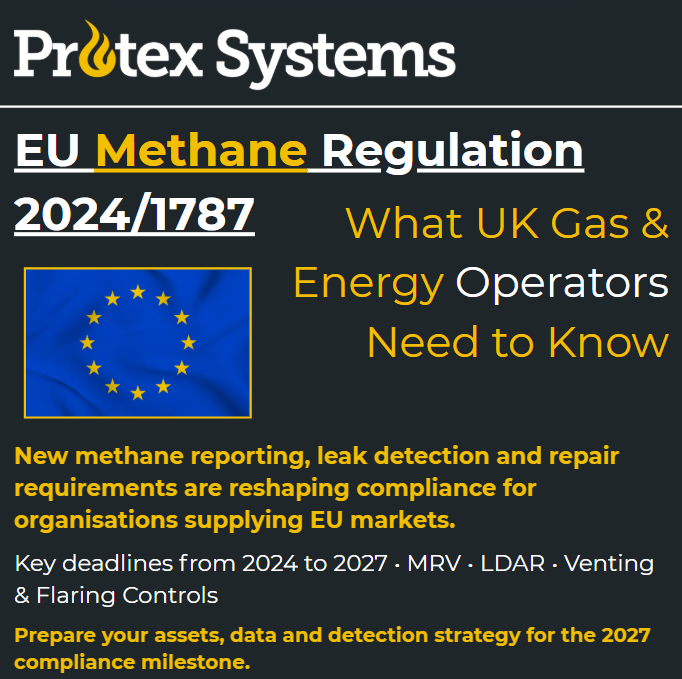
Regulation (EU) 2024/1787 is the EU’s attempt to tackle it directly. It sets binding rules for measuring, reporting and reducing methane emissions from oil, gas and coal. It entered into force on 4 August 2024 and introduces mandatory leak detection and repair (LDAR) programmes, tighter reporting and limits on venting and flaring.
Does it apply to UK companies?
For most UK operators, not directly. The regulation applies to operators in the EU and to importers of oil, gas and coal into the EU. But it can still reach you if you:
- export gas or energy products to EU markets
- own or operate assets for an EU-based parent or client
- sit within an international supply chain where partners need methane data
- want to benchmark your LDAR practice against where regulation is heading
EU importers must increasingly show that their suppliers’ monitoring, reporting and verification (MRV) is equivalent to EU standards, and that pressure flows back to producers and exporters.
What the regulation requires
Monitoring, reporting and verification. Operators must quantify and report methane emissions at source level, with independent verification. The aim is transparency about where emissions actually come from.
Mandatory LDAR. Operators must survey equipment for fugitive emissions, repair leaks within set timeframes and keep records of detections and repairs.
Limits on venting and flaring. Routine venting and flaring are restricted, with a prohibition on certain equipment from 1 January 2030.
Where the timeline stands
| Date | Milestone |
|---|---|
| 4 August 2024 | Regulation enters into force |
| 5 May 2025 | General importer reporting begins |
| September 2026 | Commission’s methane transparency database scheduled to launch |
| 1 January 2027 | Importers must show contracts concluded or renewed on or after 4 August 2024 cover only supply with EU-equivalent MRV |
| 2027 onward | Methane intensity reporting phases in, with the methodology still being finalised |
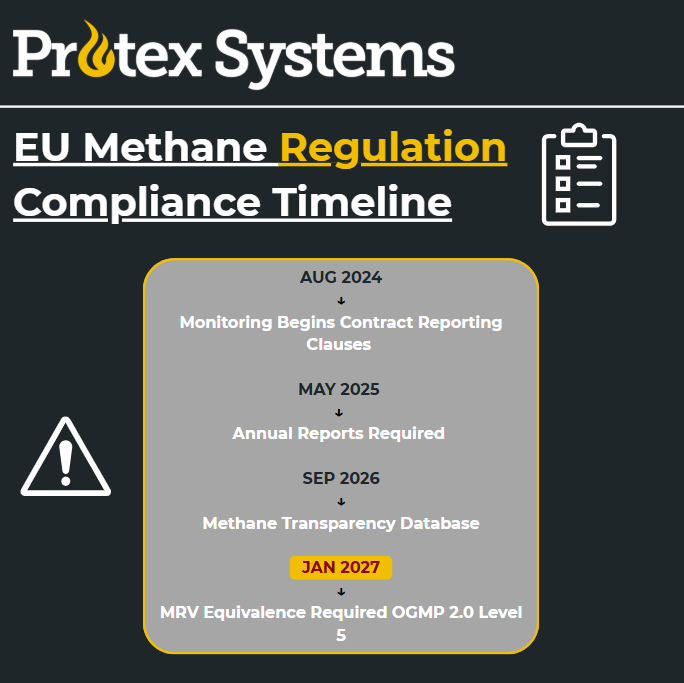
One recent development matters for planning. In July 2026 the European Commission issued a Recommendation that Member States should not apply penalties for importer failures to meet the 2027, 2028 and 2029 obligations, other than fraudulent breaches, and it will review this by 1 January 2028. The obligations still apply from January 2027, so commercial pressure from EU buyers is likely to arrive before enforcement does. [Link: EUR-Lex and European Commission pages. Please confirm the transparency database launch status before publishing.]
Type 1 and Type 2 LDAR surveys
The regulation defines two kinds of LDAR survey, each with its own detection limits and repair thresholds under Article 14:
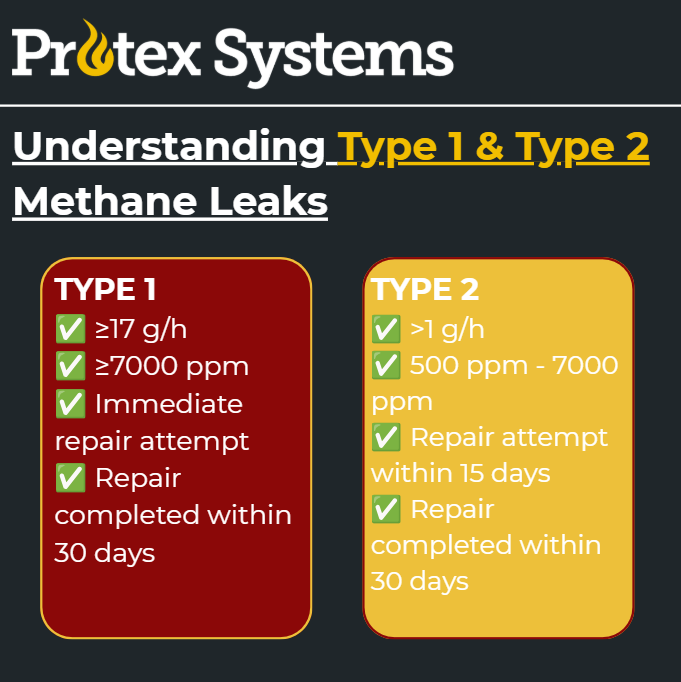
- Type 1 surveys are designed to find the larger leaks. The repair threshold is 7,000 ppm or 17 g/h of methane.
- Type 2 surveys are more granular. For above-ground components the threshold is 500 ppm or 1 g/h, with different values for underground components.
Once a leak is found, repair should happen immediately where possible. If not, a first repair attempt is required within 5 days, and the leak should be fully repaired within 30 days. Where that isn’t achievable, operators must justify the delay and set a repair schedule.
The practical goal is to find the biggest sources quickly, fix them first and keep the records to prove it.
Choosing a leak detection technology
No single technology suits every site. Here are the main options.
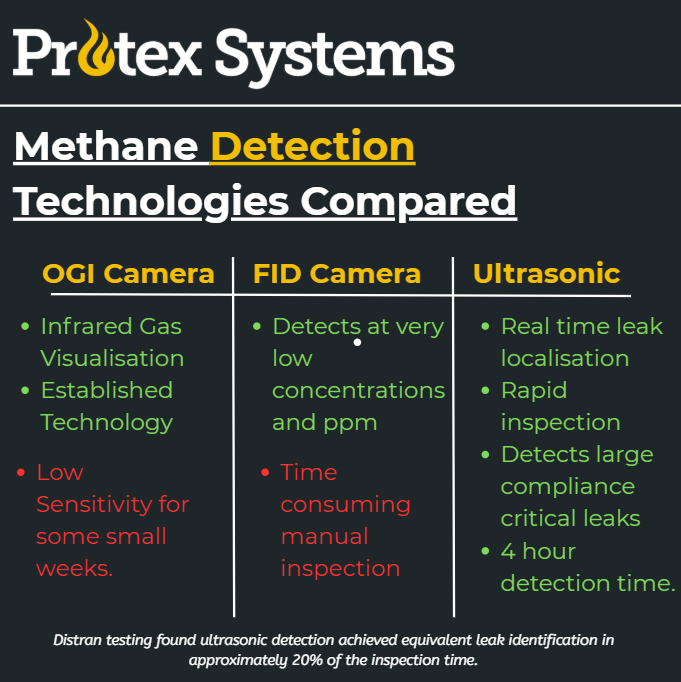
Ultrasonic gas leak detection (acoustic imaging). Ultrasonic cameras pick up the high-frequency sound made when pressurised gas escapes, and overlay the source on a visual image. They suit pressurised systems, work regardless of wind, and can survey large areas quickly from a distance. Their limits are worth knowing too. They detect the sound of a leak rather than methane itself, so they can’t tell methane from other pressurised gases. Background ultrasonic noise can affect results, and low-pressure leaks may be harder to find. [Check and state whether this technology meets the regulation’s detection limits and quantification requirements for your intended use.]
Optical gas imaging (OGI). Infrared cameras make hydrocarbon gas visible. They’re widely used in oil and gas, but results depend on weather, background conditions and operator skill.
Flame ionisation detectors (FID). Handheld FID instruments are highly sensitive, but they require close access to each component, so surveys of large sites are slow and labour-intensive.
A real-world comparison
A European gas transmission operator compared an ultrasonic camera with a combined OGI and FID approach at a medium-sized gas station. This study was supplied by the manufacturer Distran, so treat it as one data point rather than independent proof. [Link: Distran white paper.]
- Time: the OGI and FID survey took around two and a half days. The ultrasonic camera covered the site in about four hours, roughly a fifth of the time.
- Detection: both methods found a similar share of total emissions, though the ultrasonic camera missed some smaller leaks.
- Large leaks: three leaks exceeded the 17 g/h Type 1 threshold, and the ultrasonic camera found all three. The OGI and FID survey missed one, which the study put down to likely operator oversight rather than equipment limits.
The takeaway isn’t that one tool wins everywhere. Survey speed and ease of use matter alongside sensitivity, because a technically capable instrument still misses leaks if the process depends heavily on manual checks. Many operators will combine methods.
What UK operators should do now
- Review your current LDAR programme. Compare survey frequency, technology and reporting with where EU and international expectations are heading.
- Get your asset data in order. You’ll need to capture, report and audit emissions and repair records efficiently.
- Focus on the biggest sources first. Choose methods that find high-impact leaks quickly.
- Talk to your EU customers and partners. Find out what methane data they will need from you under their own obligations.
- Keep an eye on UK policy. UK venting and flaring guidance and methane reduction policy continue to develop. [Link: NSTA and UK government guidance, and add specifics.]
How Protex Systems UK can help
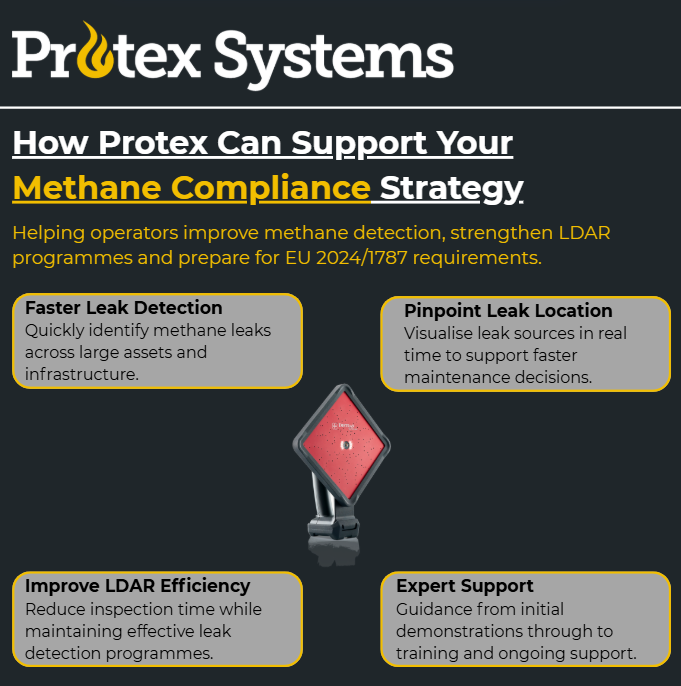
Protex Systems UK is the UK distributor for Distran ultrasonic gas imaging technology, and we work with gas, energy and industrial operators to find fugitive emissions quickly. If you’re reviewing your LDAR approach, comparing detection technologies or preparing for supply chain methane reporting, we can help you decide what suits your site, including where a different method is the better fit.
[Button: Talk to our team] · 01642 200794 · [email protected]
Frequently asked questions
What is the EU Methane Regulation?
Regulation (EU) 2024/1787 is EU legislation to reduce methane emissions from the oil, gas and coal sectors through mandatory monitoring, reporting, verification and LDAR requirements.
Does it apply to UK companies?
Not directly in most cases, but it can affect UK businesses that export to the EU, own assets for EU-based organisations or supply EU importers.
What is an LDAR programme?
Leak detection and repair is a structured process for finding, recording and fixing fugitive emissions from equipment and infrastructure.
What’s the difference between Type 1 and Type 2 LDAR surveys?
Type 1 surveys target larger leaks (7,000 ppm or 17 g/h). Type 2 surveys use more sensitive thresholds, such as 500 ppm or 1 g/h for above-ground components.
Which methane detection technology is best?
It depends on the site, pressures, access, conditions and what you need to demonstrate. Ultrasonic, OGI and FID each have strengths and limits, and many programmes use a combination.
Why does methane leak detection matter?
Leaks mean lost product, higher emissions, regulatory and customer scrutiny and potential safety risks. Finding them early cuts all four.

